Warmup: your first CLASS computation#
# import classy module
from classy import Class
# create instance of the class "Class"
LambdaCDM = Class()
# pass input parameters
LambdaCDM.set({'omega_b':0.022032,'omega_cdm':0.12038,'h':0.67556,'A_s':2.215e-9,'n_s':0.9619,'tau_reio':0.0925})
LambdaCDM.set({'output':'tCl,pCl,lCl,mPk','lensing':'yes','P_k_max_1/Mpc':3.0})
# run class
LambdaCDM.compute()
<classy.Class at 0x7708f03bf5a0>
# get all C_l output
cls = LambdaCDM.lensed_cl(2500)
# To check the format of cls
cls.keys()
dict_keys(['bb', 'ee', 'ell', 'pp', 'te', 'tp', 'tt'])
ll = cls['ell'][2:]
clTT = cls['tt'][2:]
clEE = cls['ee'][2:]
clPP = cls['pp'][2:]
# uncomment to get plots displayed in notebook
%matplotlib inline
import matplotlib.pyplot as plt
from math import pi
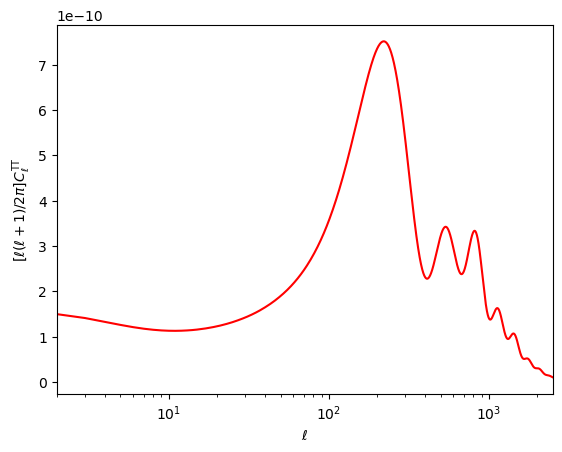
# plot C_l^TT
plt.figure(1)
plt.xscale('log');plt.yscale('linear');plt.xlim(2,2500)
plt.xlabel(r'$\ell$')
plt.ylabel(r'$[\ell(\ell+1)/2\pi]  C_\ell^\mathrm{TT}$')
plt.plot(ll,clTT*ll*(ll+1)/2./pi,'r-')
[<matplotlib.lines.Line2D at 0x7708bd5f1a90>]
plt.savefig('warmup_cltt.pdf')
<Figure size 640x480 with 0 Axes>
# get P(k) at redhsift z=0
import numpy as np
kk = np.logspace(-4,np.log10(3),1000) # k in h/Mpc
Pk = [] # P(k) in (Mpc/h)**3
h = LambdaCDM.h() # get reduced Hubble for conversions to 1/Mpc
for k in kk:
    Pk.append(LambdaCDM.pk(k*h,0.)*h**3) # function .pk(k,z)
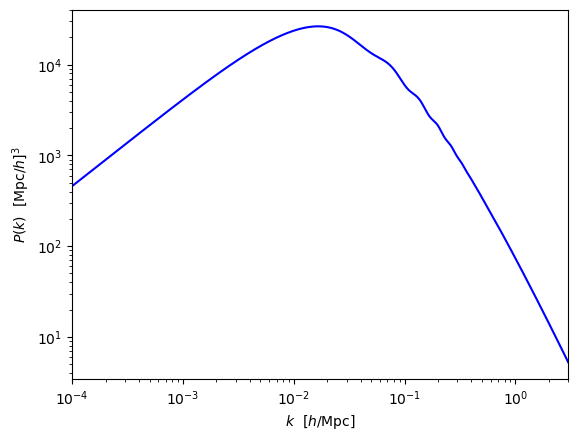
# plot P(k)
plt.figure(2)
plt.xscale('log');plt.yscale('log');plt.xlim(kk[0],kk[-1])
plt.xlabel(r'$k \,\,\,\, [h/\mathrm{Mpc}]$')
plt.ylabel(r'$P(k) \,\,\,\, [\mathrm{Mpc}/h]^3$')
plt.plot(kk,Pk,'b-')
[<matplotlib.lines.Line2D at 0x7708bc3107d0>]
plt.savefig('warmup_pk.pdf')
<Figure size 640x480 with 0 Axes>
# optional: clear content of LambdaCDM (to reuse it for another model)
LambdaCDM.struct_cleanup()
# optional: reset parameters to default
LambdaCDM.empty()
<classy.Class at 0x7708f03bf5a0>